
Summary
Design-Build is transforming how construction projects are delivered. By placing design and construction under one contract, this approach streamlines communication, cuts costs, reduces risk, and accelerates project timelines. Unlike traditional methods such as Design/Bid/Build or Construction Management at Risk, Design-Build encourages early collaboration between designers and builders, leading to more accurate pricing, fewer delays, and better overall outcomes. The result is a faster, more efficient process that gives owners greater confidence from concept through completion.
Estimated Time to Read: 7 minutes
What You’ll Learn in This Article
- The key differences between Design/Bid/Build, Construction Management at Risk, and Design-Build
- How project timelines vary under each delivery method
- Why Design-Build allows construction to start earlier
- How single-source responsibility reduces owner risk
- How early collaboration improves cost control and pricing accuracy
- The role of value engineering in reducing lifecycle costs
- Why Design-Build often produces higher quality outcomes
- Why more owners and contractors are choosing Design-Build
Design-Build Delivers Projects More Quickly and Efficiently
The design-build concept in the construction industry isn’t something new. It has been there for centuries, but in recent times, it has gained acceptance and popularity.
The Design-Build method is based on the aspect that a contractor or design-build team takes full charge and responsibility for design and construction of a project right from the conception to the completion.
When you look at the past, project delivery methods such as Design/Bid/Build (DBB) or Construction Management (CM at Risk) have been popular, however, today Design-Build has emerged to take a leading spot as a cost-efficient project delivery method.
Design-Build makes things easier for the client. It is more efficient, faster, and less costly when compared to other project delivery methods. In this article, we compare the different project delivery systems and show you why you should consider the Design-Build System.
Traditional Delivery Systems vs. Design-Build
At iiCON Construction we believe that project owners should choose the project delivery method that can best meet their unique needs.
The Design Build Institute of America (DBIA) has a brochure within their Design-Build Done Right Primer series entitled Choosing a Project Delivery Method. It provides a short overview of Design-Build in relation to the other common delivery methods.
DBIA has provided project owners with factors they need to consider to determine the best project delivery method for their project. These include the project control, relationship with designers or contractors, project budget, project schedule, and the owner risk.
To compare the different delivery systems, we thought it would help for you to understand what makes design build stand out. To do that let’s look at a recent project we bid and the process the project would go through under each of the delivery methods: design-bid-build, construction manager at risk, and design build.
Design/Bid/Build
In Design/Bid/Build, the owner hires an architect and later in the process brings in the construction team and contractors. In this method because the construction team and contractors are brought in later many issues may surface further along in the process which can affect both cost and delivery time.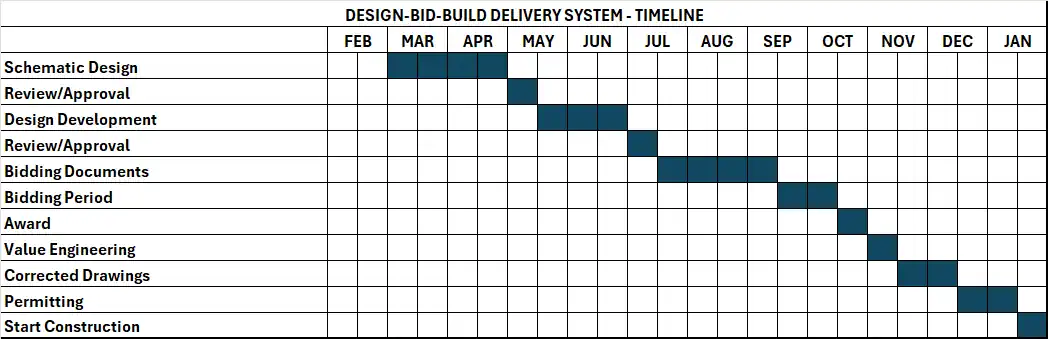
The graph above shows how the Design/Bid/Build delivery system was expected to work for the client. The design would start in March. Bidding would take place in September through October with the construction work starting in January.
Construction Management at Risk
In Construction Management at Risk, the owner hires the design firm and the Construction Manager is brought in when the design is 80% done.
The Construction Manager must commit to a price and takes the risk if the project comes in over budget. While some value engineering can be accomplished in Construction Management being involved from the very beginning offers more benefits.
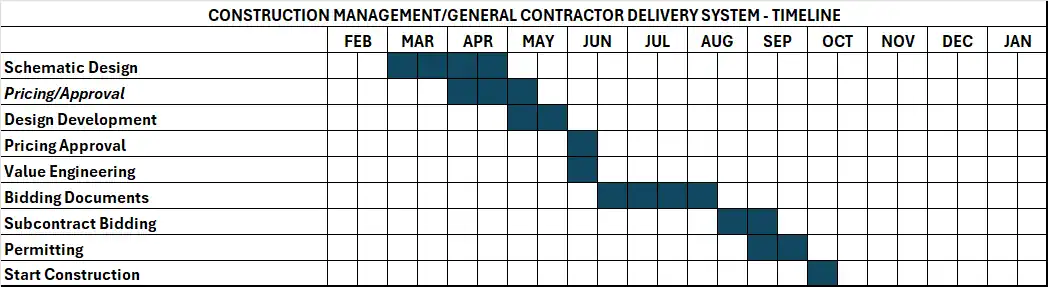
From a scheduling perspective the construction management company would help in pushing the project delivery dates. In the graph above, you can see that the design would still start in March. Bidding starts in August and construction would start in October; three months earlier than design-bid-build.
Design-Build
The third option we presented to the client was Design-Build collaboration. This project delivery system means that the design firm and the contractor work together from the beginning.
In our experience, this process is the most cost-effective because issues are identified early in the process and this allows for time and money savings.
When you look at the graph below, the preliminary design still starts in March. The key subcontractors would be involved in the project in May and by September the same year, the construction work would start.
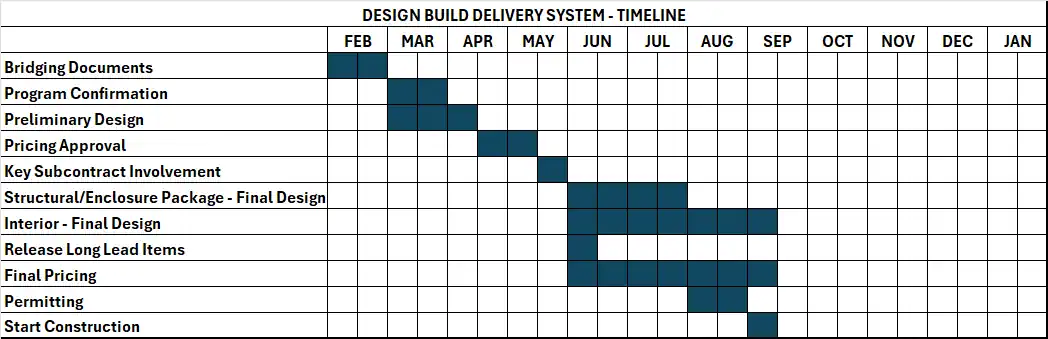
So, you can see that with Design-Build method, the construction of the project would begin earlier (in September) while with CM/GC delivery system, it would commence in October. And with the Design/Bid/Build delivery system, it would delay the start of project construction until January. This clearly shows how a project can be completed earlier with Design-Build.
Why Owners and Contractors Are Choosing Design-Build
Design-Build creates a single point of responsibility. One entity manages both design and construction. This structure improves communication, reduces risk, and enhances accountability.
In traditional methods, owners hire designers and contractors separately. If problems arise, responsibility can become unclear. With Design-Build, there is no confusion about accountability.
Collaboration is built into the process. Designers and builders work as one team with shared goals. This alignment benefits both the schedule and the budget.
Key Benefits of Design-Build
Single Responsibility
The key benefits of the design build method start with single responsibility. Architecture and construction operate under one contract. Owners do not need to manage multiple contracts or coordinate between separate firms.
This reduces financial risk and strengthens owner control. It also eliminates the potential for finger pointing between design and construction teams.
Earlier and More Accurate Pricing
Because the Design-Build team develops design and pricing simultaneously, cost estimates evolve with the project. Owners receive realistic projections early in the process.
This supports better financing decisions and improves feasibility planning. It also reduces surprises during construction.
Value Engineering from the Start
When designers and builders collaborate from the beginning, they evaluate systems, materials, and construction methods together. This leads to smarter decisions.
Lifecycle costs can be assessed alongside capital costs. Alternatives can be reviewed efficiently. The result is a balanced approach that optimizes long-term value.
Enhanced Quality
With one team responsible for both design and construction, focus remains on delivering a high-quality outcome.
There is no division between those who design and those who build. Instead, the team works together to solve problems proactively. This reduces errors and omissions.
Accountability drives performance. Because responsibility is unified, the team remains motivated to deliver the best possible product.
The Upshot
Each project delivery method has its place. However, Design-Build mitigates many of the challenges found in traditional systems.
Design/Bid/Build can delay construction and increase costs due to late-stage adjustments. Construction Management at Risk improves scheduling but still limits early collaboration.
Design-Build allows projects to start sooner and move forward more efficiently. It provides single-source responsibility, earlier pricing clarity, integrated value engineering, and enhanced quality.
For owners seeking speed, efficiency, and accountability, Design-Build continues to prove itself as a highly effective project delivery method.
iiCON Construction Colorado is an award-winning commercial builder. If you are in Colorado, contact us today to learn more about how the design - build method can work best for your project.